


Is My Guinea Pig Afraid of Me?


If you’ve ever opened the fridge and heard a sudden wheek, only to watch your guinea pig scatter the moment you move, you’ve probably asked yourself this question:
Is my guinea pig afraid of me?
It’s one of the most common worries guinea pig guardians have—and one of the most misunderstood.
The short answer?
Probably not in the way you think.
Let’s talk about what fear actually looks like, what’s normal prey-animal behavior, and how trust really grows with guinea pigs.

Fear Isn’t Personal
Guinea pigs are prey animals.
Their instincts were written long before couches, kitchens, or kind humans holding parsley. Their nervous systems are designed to keep them alive in a world where danger often comes from above.
To a guinea pig:
Fast movements = danger
Big shadows = danger
Hands reaching down = very suspicious event
None of this means they dislike you.
It means their brain is doing exactly what evolution trained it to do.
Fear ≠ dislike.

Signs of Real Fear
Sometimes, guinea pigs are genuinely scared in the moment. Watch for these signs:
A frozen body with wide, unblinking eyes
Rapid or shallow breathing
Teeth chattering
Scrambling accompanied by sharp panic sounds
Refusing food even after you leave the area
When you see this, you’re not dealing with stubbornness or attitude.
This is stress. Not sass.
If this happens frequently, it’s a cue to slow things down and reassess the environment—not a judgment on your bond.

Signs of Caution (Not Fear)
Here’s the part many people misread.
The most common scenario looks like this:
Running away, then peeking back
Accepting food once you stop moving
Staying hidden but vocal
Freezing briefly, then relaxing
This isn’t fear.
This is vigilance.
Your guinea pig is gathering information. Watching. Learning patterns. Deciding whether the situation is safe.
Caution is not rejection—it’s curiosity with boundaries.

Why Guinea Pigs Run From You
Let’s flip the perspective for a moment.
To your guinea pig, you are:
Tall
Loud (even when you think you’re quiet)
Always moving your hands
Occasionally scoop-shaped
From their point of view, you’re basically a mobile weather system with grabby tendencies.
Running isn’t rude.
It’s reasonable.

How Trust Actually Grows
Trust with guinea pigs isn’t dramatic.
It’s repetitive. Predictable. Almost boring.
That’s why it works.
Trust grows through:
The same routine, every day
Sitting at their level
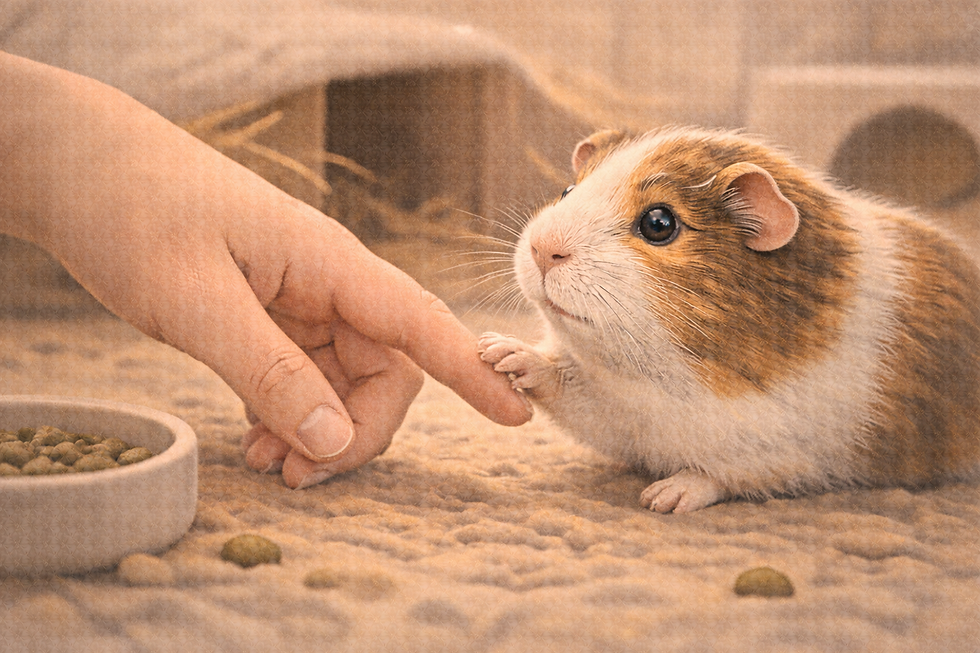
Hand-feeding without grabbing
Speaking softly and consistently
Letting them approach first
No shortcuts.
No dominance.
Just patience.

Signs You’re Doing It Right
Trust doesn’t announce itself loudly—but it leaves clues.
Look for these small wins:
They eat near you
They stay out instead of hiding
They wheek when you enter
Gentle nose boops
Occasional popcorns
Fear doesn’t popcorn.
Happy guinea pigs do.

The Truth: Is my guinea pig afraid of me?
Here’s the part many people need permission to hear:
Your guinea pig may never love being picked up.
That’s okay.
Trust doesn’t mean cuddling on demand.
Trust looks like feeling safe enough to exist near you.
Trust looks like choosing curiosity over hiding.
Trust looks quiet.
And quiet, in guinea pig language, is a compliment.
If You’re Wondering…
If your guinea pig:
Runs but comes back
Eats when you’re nearby
Stays calm more often than not
You’re doing better than you think.
Trust with guinea pigs isn’t loud love.
It’s quiet safety.
And that matters.
Looking for Guinea Pig–Approved Joy?
Some things are meant to be rushed.
Building trust with a guinea pig isn’t one of them.
If you enjoy celebrating the quiet, funny, deeply specific moments of guinea pig life, you might enjoy the Guinea Pig Gift Shop—a collection of thoughtfully designed items made by guinea pig people, for guinea pig people.
👉 Visit the Guinea Pig Gift Shop to find cozy apparel, art, and small joys inspired by the animals who taught us patience, curiosity, and calm.
Because loving guinea pigs isn’t loud.
It’s intentional. 🐹💛


Comments