


How to Bond Guinea Pigs


Help your piggies become friends, one careful step at a time
Guinea pigs are social little creatures, and most of them truly do better with companionship. A bonded pair can eat together, nap near each other, chatter back and forth, and make daily life feel a little less lonely. But getting to that point is not always instant.
Bonding guinea pigs can look messy before it looks sweet.
A little chasing, rumbling, or awkward posturing does not always mean things are going badly. In many cases, it means your pigs are simply figuring each other out. The key is to go slowly, prepare the space well, and know the difference between normal bonding behavior and a real problem.
Here’s how to give your guinea pigs the best chance at becoming friends.

Guinea pigs need friends, but bonding should be done carefully
Because guinea pigs are social animals, companionship is often a wonderful thing for them. Still, friendship should not be forced too quickly. A good bond usually takes patience, neutral space, and close supervision.
Just because guinea pigs need company does not mean you can place two pigs together and hope for the best. Thoughtful introductions matter. The more carefully you handle the first meetings, the better your odds of long-term success.

Start with the right match
Not every pairing is equally easy.
In many cases, the easiest matches are:
Two females
Two compatible males
Females with a neutered male
Temperament matters just as much as sex. Some guinea pigs are bold and confident. Others are shy, sensitive, or territorial. A calm pig may do beautifully with another calm pig, while two dominant personalities may need more care, more space, and more time.
Adult males can bond successfully, but boar pairings are sometimes trickier than female pairings. That does not mean they cannot work. It just means compatibility matters a lot.

Quarantine first
Before introducing a new guinea pig to your resident pig, keep the newcomer separate for about 2 to 3 weeks.
This step is easy to skip when you are excited, but it is important. Quarantine helps reduce the risk of illness, parasites, or other health problems spreading to the guinea pig you already have. A new pig may seem perfectly healthy and still be carrying something you do not want shared.
During quarantine, keep the newcomer in a separate enclosure in another room if possible. This gives you time to observe eating, pooping, breathing, energy level, and overall health before any face-to-face meeting happens.

Use neutral territory
The first introduction should never happen in your resident guinea pig’s cage.
That cage already smells familiar. It already feels owned. Bringing a new pig into that space too soon can trigger territorial behavior and turn the introduction sour before it really begins.
Instead, choose a place that feels new to both guinea pigs, such as:
A floor pen
A bathroom
A hallway
A play area
Neutral territory helps level the playing field. Neither pig has home-field advantage, which can make the interaction less tense.

Set the scene for success
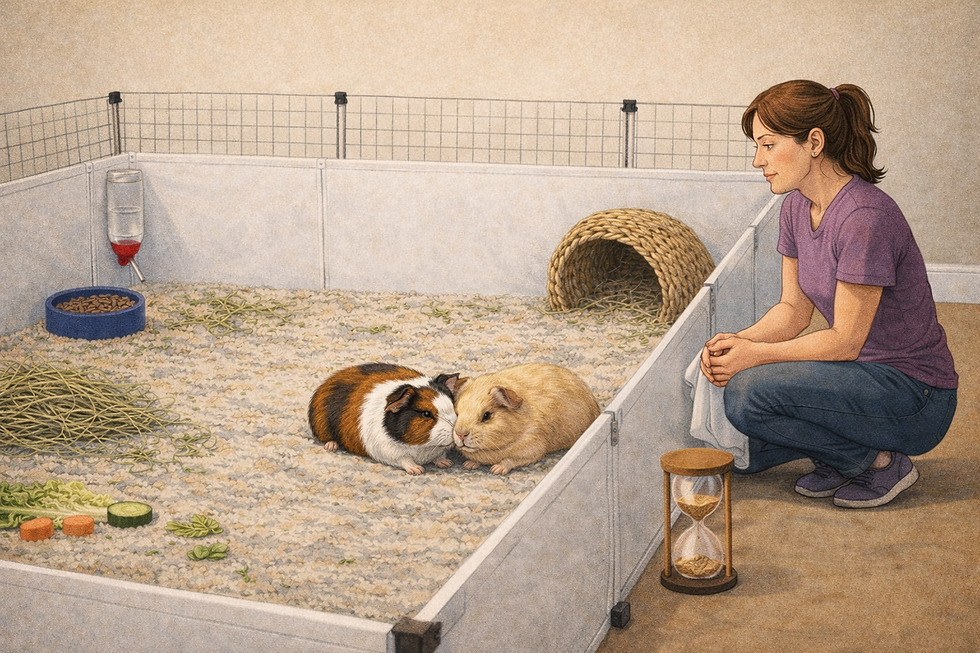
Once you’ve picked your neutral area, prepare it with bonding in mind.
A good bonding area should include:
Big piles of hay
Scatter veggies
Open space to move around
Hay works like guinea pig diplomacy. It gives them something to do, something to share, and something comforting to focus on. Scattered veggies can also help keep the mood busy and positive.
At first, skip items that may encourage guarding, such as:
Small houses with one entrance
Tight corners
Pellet bowls
You want the space to feel open, not trap-filled. If one pig can corner the other or claim a resource too easily, tension can rise fast. Fresh towels, lots of room, water, and hay usually create a much smoother first meeting.

Expect some drama
This is the part many people find nerve-rattling.
When guinea pigs first meet, some behaviors can be completely normal:
Chasing
Mounting
Rumble strutting
Nose-offs
Some teeth chattering
They are often sorting out their social order. One pig may act more dominant. The other may test boundaries. It can look rude, awkward, and a little theatrical. Guinea pigs are tiny, but they know how to stage a surprisingly dramatic social performance.
That does not automatically mean the bond is failing.
Some tension during early bonding is common. Mild dominance behavior is part of many successful pairings.

Know the red flags
While some awkwardness is normal, true aggression is not.
Separate the guinea pigs if you see:
A real rolling fight
Repeated biting
Blood drawn
One pig is being prevented from eating or drinking
These are signs that things have moved beyond ordinary bonding behavior. If a true fight breaks out, use a towel to separate them rather than your bare hands. Angry guinea pigs can bite hard, and a towel gives you a safer way to intervene.
A few squabbles are one thing. Relentless aggression is another.

Don’t interrupt too soon
This part can be hard for pig parents. You want to help. You want to stop the tension. But if there is no real fight, it is often better to let the pigs work through the awkward phase.
Stopping too early can reset the process.
That does not mean ignoring them. It means watching calmly and closely. Stay nearby. Supervise carefully. But do not panic over every chase, rumble, or stare-down.
Guinea pigs often need time to establish their relationship. If you interrupt every normal dominance moment, they may never get far enough to settle into a clearer social rhythm.

Move them into a fresh cage
Once the introduction goes well, move both guinea pigs into a thoroughly cleaned cage.
This step matters more than it may seem. A freshly cleaned habitat helps prevent one pig from feeling like the space already belongs to them. Rearranging the layout also helps the cage feel new to both pigs.
Make sure the cage has:
Plenty of space
Multiple hides
Multiple hay spots
Multiple water sources
Think of it as setting up a tiny shared apartment after a first date went surprisingly well. You want enough room, enough resources, and no reason for either roommate to start a lettuce dispute.
Duplicates help reduce competition. When each pig has access to what they need, the bond often has a much better chance to settle in.
Bonding takes patience
Even after a good introduction, the first days may still be noisy and awkward.
That does not always mean failure.
Many bonded guinea pigs begin with:
Chasing
Rumbles
Minor squabbles
Friendship can look messy before it looks cozy.
Some pairs settle quickly. Others take more time. Mild dominance behavior may still show up early on, even after they move into the same cage. What matters is whether the overall relationship is moving in a safer, calmer direction.
Two guinea pigs relaxing near the same hay pile may not look like a grand romantic finale, but in guinea pig language, it is beautiful progress.

Final thoughts
Bonding guinea pigs is not about forcing instant friendship. It is about creating the right conditions for trust, structure, and companionship to grow.
Go slowly. Use neutral territory. Give them space. Learn what normal bonding looks like. And know when to step in if things become truly unsafe.
Some guinea pigs click quickly. Others need more time and a little more patience from the humans supervising the process. That is normal.
In the end, the goal is not a perfect first meeting. The goal is a stable, healthy relationship that can grow into something sweet.
Follow The Cavy Whisperer for trusted guinea pig care tips. Visit our Guinea Pig Gift Shop to support rescues and the Cavy Whisperer. Find our music on your favorite music streaming service.


Comments